
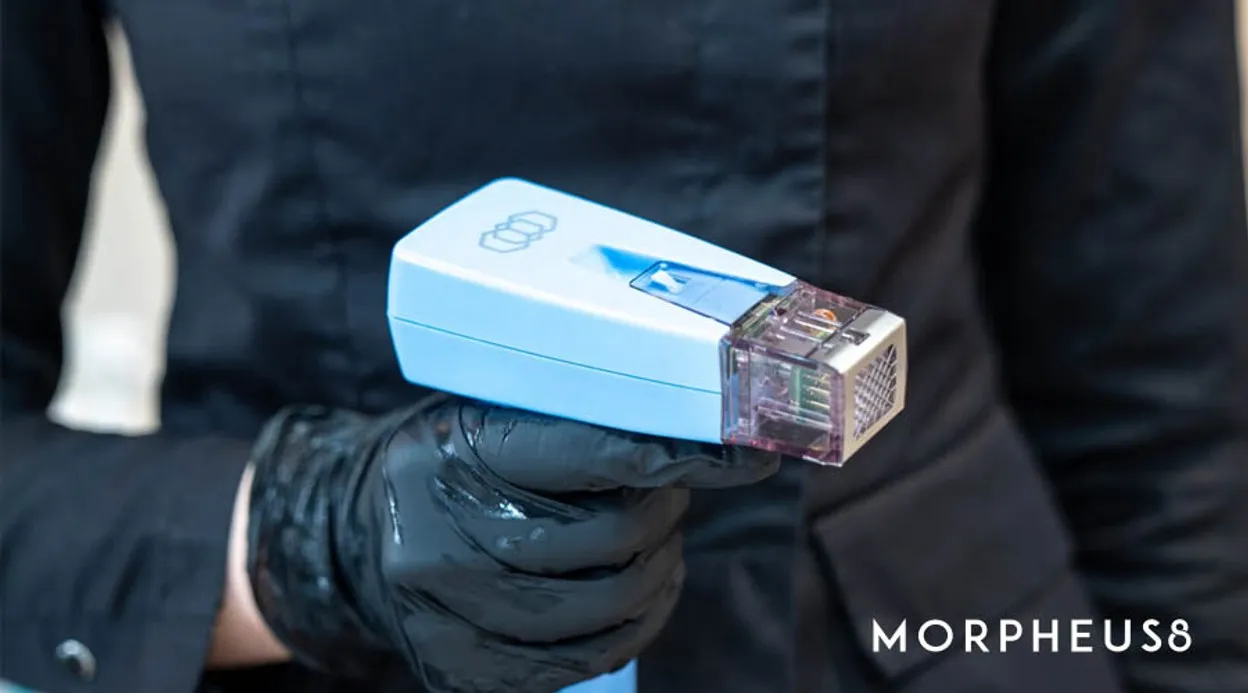
Ask who is legally allowed to hold a Morpheus8 handpiece and the answer changes depending on which side of the border the clinic sits. In England the honest answer today is close to anyone: no licensing scheme is in force, and the one proposed would still let a non-healthcare professional perform this treatment under supervision. Scotland has taken a materially stricter line, in two separate places. One is already law. The other is a proposal with no published start date. Most coverage runs the two together; this article does not.
The machine is one question, the operator is another
Regulation of an energy-based treatment splits in two, and the halves sit with different bodies. Whether the device may be sold and used here at all is an MHRA question: devices placed on the Great Britain market must be registered, and a manufacturer based outside the UK must appoint a UK Responsible Person. Two gaps deserve naming: no MHRA registration record, and no UKCA or CE certificate details, could be confirmed for this device from a primary source, and no MHRA safety alert specific to radiofrequency microneedling was identified.
Who may switch the device on, in what premises and after what training, is the other question. Scotland and England answer it separately, and at present very differently.
| Scotland | England | |
|---|---|---|
| In force today | Independent healthcare services must register with Healthcare Improvement Scotland | No licensing scheme for these procedures |
| Where this treatment lands | Group 3: microneedling deeper than 1.5 mm, or any listed procedure under anaesthetic | Amber: radiofrequency and microneedling combined in a hybrid device |
| Who could then perform it | Doctor, dentist, prescribing nurse or prescribing pharmacist | A non-healthcare professional, licensed and overseen by a regulated professional |
| Status | Consultation response, June 2025, no commencement date | Consultation response, further consultation and Parliamentary time needed |
What is already law in Scotland
Independent healthcare services in Scotland must register with Healthcare Improvement Scotland. Not guidance, not a voluntary quality mark: providing an unregistered independent healthcare service is an offence under section 10Z9 of the National Health Service (Scotland) Act 1978.
The duty attaches to the service rather than to any single treatment, and whether a given provider sits inside that definition depends on how it is set up, which is why asking beats assuming. Healthcare Improvement Scotland wants more than this, and said so: it supported further regulation of these procedures in its own consultation response of April 2025.
The three group model, and what stage it has reached
In June 2025 the Scottish Government published its response to a consultation on regulating and licensing non-surgical cosmetic procedures. It proposes sorting them into three groups.
Group 1 would sit with local authority licensing of premises under the Civic Government (Scotland) Act 1982, unless the procedure happens somewhere already regulated by Healthcare Improvement Scotland. As proposed, it includes microneedling to a depth of 1.5 mm, and radiofrequency treatments.
Group 3 is the restricted end, limited to an appropriate healthcare professional: a doctor, dentist, prescribing nurse or prescribing pharmacist. As proposed, it includes microneedling where the needles used penetrate the skin to a depth greater than 1.5 mm, and any procedure listed in Group 1 or Group 2 where an anaesthetic is used.
Now the status, because this is where consumer coverage goes wrong. These are proposals: a response to a consultation, not a commenced scheme, and nothing in them restricts who may perform this treatment in Scotland today. The published page gives no commencement date, and although trade press has reported a Non-Surgical Cosmetic Procedures Bill as the intended vehicle, the date is not available from primary sources. A clinic that tells you exactly when this starts is telling you something the documents do not say.
Why this treatment lands in Group 3 twice over
Depth first. The manufacturer’s operator manual offers needle depths of 1 to 7 mm depending on the tip, with roughly 1 mm of additional thermal effect beyond where the needle stops. Published practice is more modest: facial treatment typically 1 to 2 mm, body treatment 3 to 4 mm, and 4 mm at the jowl.
Set the Scottish line at 1.5 mm and most of that range sits above it. The exceptions are real: the resurfacing tip is fixed at 0.5 mm, and a 1 mm facial pass falls below the line. But the depths that make this device distinctive, and that clinics advertise, are all above it. Depth is the entire technical argument for the machine, which is why the settings menu repays reading in detail before any consultation.
Anaesthesia then catches the treatment a second time, whatever the depth, because Group 3 as proposed takes in any listed procedure where an anaesthetic is used. This one is rarely performed without. The published facial protocol uses a topical gel of 23 percent lidocaine and 7 percent tetracaine left on for one to two hours beforehand, and in the largest published cohort, where the device was combined with another radiofrequency procedure, 97.2 percent of treatments were carried out under local anaesthesia. A procedure that needs an hour of numbing before it starts is not a facial. One caveat, since precision is the point here: the wording says an anaesthetic, and whether a topical gel counts alongside an injected local is a detail the final drafting has to settle.
Who counts as an appropriate healthcare professional
The Group 3 list is short: doctor, dentist, prescribing nurse, prescribing pharmacist. It is narrower than the phrase healthcare professional suggests. A registered nurse without prescribing rights is not on it as written, and nor is anyone whose qualification for this work is a manufacturer’s training course. The manufacturer sets a bar of its own, restricting the equipment in its operator manual to qualified medical professionals trained in the particular technique: looser than Scotland proposes, tighter than much of the marketing implies.
England, and why the same treatment sits under different rules
No licensing scheme for non-surgical cosmetic procedures is in force in England. The power to create one exists under section 180 of the Health and Care Act 2022 and has not been used. The Government consulted between 2 September and 28 October 2023 and received over 11,800 responses.
Its proposals use a three tier green, amber and red classification. Microneedling on its own is green, the lowest tier, and radiofrequency treatments are amber. The combination is named explicitly in amber: the response describes combining two or more technologies to create a hybrid device, and gives radiofrequency plus microneedling as its example. That is this device, described in all but brand name.
Here is the difference that matters. Under the English amber proposals a non-healthcare professional could still perform the procedure, holding a licence and working under oversight by a named regulated healthcare professional, while a regulated healthcare professional could perform it without oversight. Only red tier procedures would become CQC regulated activities requiring registered premises. Under Scottish Group 3, a non-healthcare professional could not perform it at all. Same device, same evidence base, two answers. Several respondents pressed for a Level 7 qualification requirement in amber, and the response did not mandate one.
Premises licensing is a separate layer again, and patchier still: in Greater London a special treatment licence under Part II of the London Local Authorities Act 1991 commonly covers radiofrequency machines, while elsewhere it varies by council. That licenses the room, not the practitioner.
Regulated does not mean proven
It is easy to hear that a treatment is regulated and assume some authority has weighed the results. None has.
Morpheus8 is 510(k) cleared by the FDA, not FDA approved: a substantial equivalence pathway, meaning the device sufficiently resembles one already on the market, not that it works. No clearance names wrinkles, skin tightening, acne scars, cellulite, stretch marks, body contouring or fat reduction. The cleared wording covers electrocoagulation, haemostasis, and coagulation or contraction of soft tissue.
On 15 October 2025 the FDA published a safety communication on radiofrequency microneedling reporting burns, scarring, fat loss, disfigurement, nerve damage and the need for surgical repair, and stating flatly that this is a medical procedure, not a cosmetic treatment. Nor has any randomised trial of the device against sham been published: the one independent systematic review that excluded industry funded studies rates the evidence base at Level of Evidence 5, the lowest rung, and names user error as the largest single source of complication risk.
Read that beside the Scottish proposals and the direction of travel makes sense: not a finding that the treatment fails, but a response to what user error at depth does.
Registration is already law in Scotland. The restriction on who may perform the treatment is not. Mistaking one for the other is the easiest error to make about this.

What to check today, wherever you are
Licensing is pending everywhere in the UK, but registration is already law in Scotland.
Ask whether the service is registered with Healthcare Improvement Scotland, and for the registration details rather than a reassurance. Ask who will hold the handpiece, what they are registered as and what their registration number is, then check it with their regulator yourself. Ask the depth in millimetres and whether an anaesthetic will be used, because those two facts decide which Scottish group the procedure falls into and they also decide the risk. Ask who reviews you if something goes wrong, and whether the person treating you can prescribe. A fuller list of questions is worth taking into the room.
If what is bothering you is a changing mole, an undiagnosed skin condition or scarring nobody has assessed, see a GP or a dermatologist before booking anything cosmetic. If it is laxity or texture, book a consultation with us: we will tell you who would treat you, what they are registered as, and what depth they would use and why.
At a glance
Scotland's position, weighed honestly
+ Reasons in favour
- One layer is already law rather than a proposal: independent healthcare services in Scotland must register with Healthcare Improvement Scotland, and providing an unregistered service is an offence under section 10Z9 of the National Health Service (Scotland) Act 1978
- The proposed Group 3 restriction is drawn around the two things that genuinely change the risk of this treatment: needle depth beyond 1.5 mm, and whether an anaesthetic is used
- If the proposals commence as drafted, a patient in Scotland would have a clearer answer to the question of who is legally allowed to do this than a patient in England currently has
− Reasons for caution
- The three group model is a consultation response, not a commenced statutory scheme. It restricts nobody today, and no commencement date is available from primary sources
- Registration with Healthcare Improvement Scotland covers how a service is run. It is not a finding that this treatment works, and no clearance anywhere names a cosmetic outcome
- The rules attach to the address rather than the treatment, so the same procedure sold by the same chain can sit under different requirements at two branches a few hundred miles apart
Frequently asked questions
The short version.
01Can a beauty therapist legally perform Morpheus8 in Scotland right now?
There is no commenced national scheme in Scotland that restricts this treatment to a particular profession, so the honest answer today is that the restriction people have read about is still a proposal. What is already law is different and often confused with it: independent healthcare services in Scotland must register with Healthcare Improvement Scotland, and providing an unregistered independent healthcare service is an offence under section 10Z9 of the National Health Service (Scotland) Act 1978. Whether a given provider falls inside that definition depends on how the service is set up, which is why asking for registration details is more useful than assuming.
02What is Group 3 under the Scottish proposals?
The Scottish Government's June 2025 consultation response proposes sorting non-surgical cosmetic procedures into three groups. Group 3 is the restricted end, limited to an appropriate healthcare professional, defined as a doctor, dentist, prescribing nurse or prescribing pharmacist. It includes microneedling where the needles penetrate the skin to a depth greater than 1.5 mm, and any procedure listed in Group 1 or Group 2 where an anaesthetic is used. Morpheus8 meets both of those descriptions in ordinary practice.
03Is the position different in England?
Yes, and currently it is looser. No national licensing scheme for non-surgical cosmetic procedures is in force in England. The power to create one exists under section 180 of the Health and Care Act 2022, and the Government consulted between 2 September and 28 October 2023, receiving over 11,800 responses. Its proposed scheme classes the combination of radiofrequency and microneedling into a hybrid device as amber, a tier under which a non-healthcare professional could still perform the procedure with a licence and oversight by a named regulated healthcare professional.
04Does Healthcare Improvement Scotland registration mean the treatment is proven?
No, and the two questions are unrelated. Registration is about how a service is run and inspected, not about whether a particular device produces a particular cosmetic result. Morpheus8 is 510(k) cleared by the FDA rather than approved, no clearance names wrinkles, skin tightening, acne scars, cellulite, stretch marks, body contouring or fat reduction, and no sham controlled randomised trial of the device has been published.
05What should I ask a Scottish provider before booking?
Four things. Whether the service is registered with Healthcare Improvement Scotland, and its registration details. Who will hold the handpiece, their professional registration and their registration number, so you can check it yourself. The needle depth in millimetres and whether an anaesthetic will be used, since those two facts decide which group the procedure would fall into. And who reviews you if something goes wrong, including whether the person treating you is able to prescribe.