
Open a dozen UK clinic pages for Morpheus8 and the same phrases come back in the same order: “FDA approved”, “clinically proven”, “body contouring”, “a non-surgical alternative to a facelift”, “minimal downtime”, “safe for all skin types”, “results last 1 to 3 years”. Read enough and the repetition starts to feel like corroboration. It is not. Most of those phrases trace back to marketing material rather than to any regulator or any trial, and several are contradicted by documents anyone can download for nothing.
None of which makes a reader foolish for believing them. The claims are everywhere and confidently written, while the documents correcting them are dry, numbered and buried on government websites. So here is each one, checked against what the clearances say and what the studies measured.
The claims, side by side
| The claim, as it usually appears | What the record supports |
|---|---|
| “FDA approved” | 510(k) cleared, a substantial equivalence pathway, not a finding that it works |
| “Cleared for skin tightening” or “for wrinkles” | Covers electrocoagulation, haemostasis and coagulation or contraction of soft tissue |
| “Body contouring”, “fat melting”, “fat reduction” | No clearance mentions any of it. The FDA lists fat loss among reported harms |
| “Treats cellulite” | Profound, not Morpheus8, holds the FDA cellulite indication |
| “Removes stretch marks” | No Morpheus8 specific evidence identified |
| “A non-surgical alternative to a facelift” | The largest dataset combined the device with a second procedure |
| “Better than laser” | An independent randomised neck trial favoured 1550 nm laser, 42.1 percent to 8.6 percent |
| “Safe for all skin types” | Energies above 62 millijoules per pin are restricted to Fitzpatrick types I to IV |
| “Minimal downtime” | The manufacturer’s manual describes oedema and crusting over 1 to 3 weeks |
| “Results last 1 to 3 years” | The longest published follow up averages 2.1 years, sponsor funded |
| “Clinically proven” | Level of Evidence 5 in the one review that excluded industry funded studies |
| “Just a cosmetic treatment” | The FDA states this is a medical procedure, not a cosmetic treatment |
Start with the word approved
This is the claim doing the most work, and the easiest to check. Morpheus8 has never been FDA approved. It is 510(k) cleared, a pathway with a much lower bar, in which a manufacturer shows a device is substantially equivalent to one already on the market. Clearance is not a finding that the device works.
It is regulated as a Class II electrosurgical cutting and coagulation device, first cleared under the Morpheus8 name as K192695 on 27 December 2019, built on an earlier InMode device cleared in June 2018, with three further clearances since, the latest in June 2024.
Now read the wording. The 2019 clearance covers dermatologic and general surgical procedures for electrocoagulation and haemostasis; the 2023 clearance expanded that to procedures where coagulation or contraction of soft tissue, or haemostasis, is needed. Haemostasis means stopping bleeding. Nothing in any Morpheus8 clearance names wrinkles, acne scars, cellulite, stretch marks, skin tightening, body contouring or fat reduction. Not one. Nor does any clearance tie a needle depth or an energy level to a cosmetic result, worth remembering when a plan is quoted to you in millimetres.
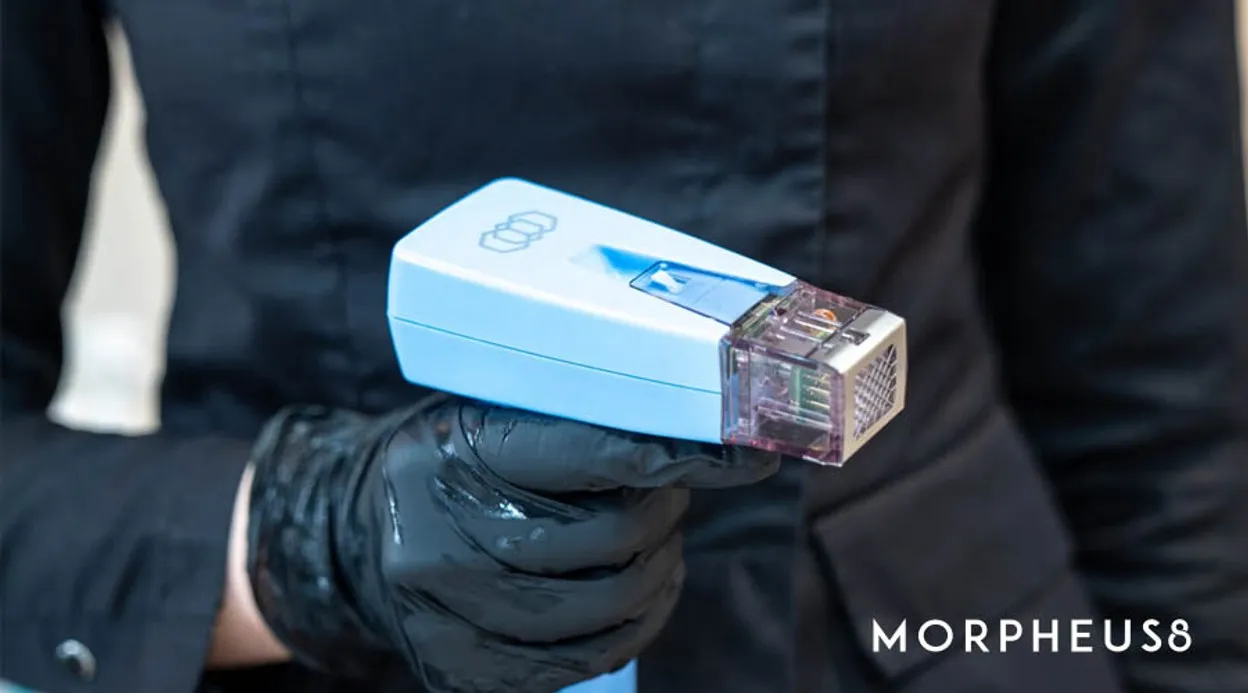
This is not a quirk of the category. Vivace is cleared for facial wrinkles in Fitzpatrick types I to V, Profound for facial wrinkles and the appearance of cellulite in types I to III. Morpheus8’s paperwork says something narrower, and the manufacturer’s own 2024 announcement puts it precisely: the first and only fractional radiofrequency microneedling device cleared for soft tissue contraction. A different claim from those further down the page.
The body claims: contouring, cellulite and stretch marks
“Subdermal adipose remodelling” sounds like a clinical term. It is a marketing category, coined by the manufacturer when the body platform launched in September 2020. No clearance for this device mentions fat reduction or body contouring in any form.
What exists instead is evidence pointing the other way. The FDA lists fat loss among the harms reported to it, and the one fully independent study to name Morpheus8 here, a retrospective review of 180 face and neck lift patients, describes contour irregularities related to greater subcutaneous fat loss where needles had penetrated. Fat at depth is affected. The disagreement is over whether that is the product or the problem.
Cellulite is cleaner still: Profound, not Morpheus8, holds the FDA indication covering its appearance. The only Morpheus8 cellulite publication is a case series with no retrievable sample size and no outcome data, in a supplement linked to the manufacturer. For stretch marks there is no device specific evidence at all, only a class level statement in a review of the wider field. Both gaps deserve a longer look.
The comparison claims: facelifts and lasers
Two claims measure Morpheus8 against something else, and both misdescribe the study underneath.
The facelift comparison rests on the largest dataset in the literature: 247 patients treated on the face and neck, a 1.4 point improvement on the Baker face and neck score, 93 percent pleased. Those are real numbers. What tends to be left out is that the patients were not treated with Morpheus8 alone. The protocol combined it with radiofrequency assisted lipolysis, a separate procedure performed under the skin, and a result produced by two interventions cannot be credited to one. The independent surgical literature adds a harder point: in that 180 patient series, earlier deep radiofrequency microneedling made later surgical correction more difficult, with a deep neck lift required in 91 percent of cases.
The laser comparison is the wrong way round. In an independent randomised study of 21 patients treating neck wrinkles, 1550 nm non-ablative fractional laser improved wrinkle scores by 42.1 percent against 8.6 percent for radiofrequency microneedling. Two caveats: it is small, and it tested radiofrequency microneedling as a class rather than Morpheus8 specifically. It is still the only independent randomised head to head, and it does not favour the needles.
The experience claims: downtime, skin type and longevity
Three more claims describe what having it done is like, and all three are gentler than the documents.
On recovery, published protocols report 2 to 5 days, which is where clinics get their figure. The manufacturer’s own manual describes oedema and crusting resolving over 1 to 3 weeks, and review literature records grid marks lasting 1 to 2 weeks. Plan around the wider range.
On skin tone, the clearance restricts energies above 62 millijoules per pin to Fitzpatrick types I to IV, and the manufacturer’s manual advises that types V and darker VI are treated with caution, capped at energy level 20. Review literature recommends reducing energy by 20 to 30 percent in types IV to VI and avoiding the 0.5 mm resurfacing tip in V and VI. Treatment with those adjustments is reasonable. A claim that no adjustment is needed is a different statement.
On longevity, the longest peer reviewed follow up averages 2.1 years, in a retrospective study funded by the manufacturer, and no controlled durability data exist. The familiar one to three year range traces to clinic marketing rather than to any published follow up. Set against a UK course costing roughly £560 to £3,240, that distinction is worth money.

“Clinically proven”, and who paid for the proof
The evidence base is not empty. It is thin, and unusually concentrated in one place.
No sham controlled randomised trial of Morpheus8 has been published, so nothing compares the device against a convincing placebo, the standard way of separating a treatment’s effect from healing, technique and expectation. The one systematic review that excluded industry funded studies rates the radiofrequency microneedling evidence base at Level of Evidence 5, the lowest rung.
Then the structural point, which almost never travels with the studies it applies to. A large share of the Morpheus8 literature sits in journal supplements sponsored by InMode and written by InMode consultants, the flagship face and neck datasets included. That does not make findings false, but “multiple published studies” implies independent replication, and using the phrase without naming who paid is misleading.
The independent work in the same literature is the smallest in it: a 20 patient body series that declared no financial interest, and the 180 patient surgical review that recorded harm. For stretch marks, and for any sham controlled trial, there is nothing to list at all.
The claim made by omission
The last claim is rarely written down. It is implied by where the treatment is sold and what it sits beside on the price list. On 15 October 2025 the FDA published a safety communication on radiofrequency microneedling reporting burns, scarring, fat loss, disfigurement, nerve damage and cases needing surgical repair, and stating that this is a medical procedure, not a cosmetic treatment. Two professional societies responded by urging members to add those risks to their consent forms. That is the framing to carry into a consultation, and it is why a celebrity association, however famous, is market history rather than clinical data.
Correcting the claims is not a verdict against the device. It is the beginning of an honest conversation about it.
What to do with a clinic page now
None of this says the machine does nothing. The honest description is narrower than the advertised one: controlled heat delivered into soft tissue through insulated needle electrodes, cohorts reporting improvement in laxity scores, and a regulatory record that stops at coagulation and contraction.
So read the next page you find with two questions in hand. Which of these words appear in a clearance, and which appear only here? And who funded the study behind that number? Book a consultation with us and we will go through what is documented, what is genuinely uncertain, and whether this is the right tool for what is bothering you, including the times when the answer is that it is not.
At a glance
What survives the fact check, and what does not
+ Reasons in favour
- Every claim here can be checked by anyone. The FDA clearance summaries, the manufacturer's operator manual and the studies themselves are all public documents, so no reader has to take a clinic's word for it
- The cleared indication is narrow but real and specific: dermatologic procedures where coagulation or contraction of soft tissue, or haemostasis, is needed
- Parts of the record are genuinely supportive. The largest dataset, 247 patients treated on the face and neck, reports a 1.4 point improvement in Baker face and neck score with 93 percent of patients pleased, although the device was combined with a second procedure
− Reasons for caution
- No sham controlled randomised trial of Morpheus8 has been published, so nothing in the literature separates the device's effect from healing, technique and expectation
- The flagship datasets sit in journal supplements sponsored by InMode and written by InMode consultants, which is almost never mentioned when a page cites multiple published studies
- For two of the most heavily advertised uses there is effectively nothing device specific: no Morpheus8 stretch mark evidence has been identified, and the single cellulite case series has no retrievable sample size or outcome data
Frequently asked questions
The short version.
01Is Morpheus8 FDA approved?
No. It is 510(k) cleared, which is a different and much lower bar. Clearance means the manufacturer showed the device is substantially equivalent to one already on the market, not that a regulator found it works. Morpheus8 is regulated as a Class II electrosurgical cutting and coagulation device, and the current cleared wording covers dermatologic procedures where coagulation or contraction of soft tissue, or haemostasis, is needed. A clinic advertising it as approved is stating something untrue.
02Which claims about Morpheus8 are actually supported?
The narrow ones. The device delivers radiofrequency heat at depth through insulated needle electrodes, and the clearance recognises that this coagulates and contracts soft tissue. Published cohorts report improvement in facial and neck laxity scores with high patient satisfaction. What is not supported is anything naming a specific cosmetic outcome as cleared, anything about fat or cellulite or stretch marks, and anything implying the results have been proven against a control.
03Are there published studies behind Morpheus8?
Yes, and their funding matters. A large share of the literature appears in journal supplements sponsored by InMode and written by InMode consultants, including the flagship face and neck datasets, the acne paper and the main facial applications review. That does not make the findings wrong, but it does mean multiple published studies is not the same as independent replication. The fully independent work in this field is small in volume, and one of its clearest signals is a harm signal.
04How long do Morpheus8 results actually last?
Nobody can say with confidence. The longest peer reviewed follow up averages 2.1 years, in a retrospective study funded by the manufacturer, and no controlled durability data exist. The one to three year range quoted so widely online traces to clinic marketing rather than to any published follow up, so treat it as a sales figure rather than a finding.
05Is Morpheus8 a cosmetic treatment or a medical procedure?
The FDA's position, published in its safety communication of 15 October 2025, is that radiofrequency microneedling is a medical procedure and not a cosmetic treatment. That communication reports burns, scarring, fat loss, disfigurement, nerve damage and cases needing surgical repair. Two professional societies responded by urging members to add those specific risks to their consent forms. Whatever it is sold alongside, it belongs in the medical column.