
Worth it is the one Morpheus8 question with no documented answer, because worth is not a property of the device. It is a ratio: what you pay, set against what the evidence can honestly carry. Both halves are public, so this article sets them side by side. It cannot tell you yes or no, because nobody who has not examined your skin can, but it can tell you what a course really costs, what the evidence supports, and when a quote is defensible.
What a course actually costs in the UK
The figures below come from UK clinic websites captured during research in 2026, and they move often. Read them as a map of the market, not as a quote.
| Area treated | Single session | Course of 3 |
|---|---|---|
| Eye area | £399 to £625 | £945 to £1,450 |
| Full face | £500 to £1,580 | £1,650 to £2,200 |
| Face and neck | £620 to £1,250 | £1,750 to £3,000 |
| Neck or chin alone | £200 to £400 | £560 to £1,120 |
| Body, abdomen and similar | £300 to £1,800 | £840 to £3,240 |
So the headline is £200 to £1,800 a session and £560 to £3,240 for a course of three. One London provider describes the market as running from about £400 at budget clinics to £900 to £2,200 at premium London ones.
One trap inflates the top of that range wherever these figures get repeated. A London clinic lists a body package at £3,835, which is a course of six, not three; its course of three for the same area is £2,159. Any price near four thousand pounds should prompt one question first: how many sessions does it buy?
The table also hides that the platform is not what you are paying for. Operator seniority is. At one London clinic a full face is £1,050 with a senior doctor and £1,580 with a lead doctor, on the same device in the same building. That difference is the practitioner, which makes it the most useful line in any price list, because it is the variable you can interrogate. The questions that get a straight answer are rarely about the machine at all.
Three sessions, or six?
Session count is the multiplier that turns a price into a bill, and the published and commercial answers differ. In the largest peer reviewed cohort the protocol was 1 to 3 sessions spaced 3 to 6 weeks apart, and the peer reviewed acne work used 3. UK clinic guidance commonly stretches this to 3 to 6 sessions at the same spacing.
No peer reviewed protocol runs to six. A recommendation of six is a commercial figure rather than a clinical one, and it roughly doubles what a course costs. That does not make it wrong, but it makes it fair to ask what the number rests on. What actually changes between sessions is worth knowing before you agree to how many there will be.

The evidence you are buying
Now the other half: everything published on Morpheus8, indication by indication.
| Sold for | Best available evidence | Patients | Independence |
|---|---|---|---|
| Face and neck laxity | Retrospective cohort, reported twice | 247, same cohort twice | Manufacturer funded, authors consultants |
| Laxity after a facelift | Small prospective study | 9 | Same research group |
| Facial safety | Retrospective safety review | 364 zones | Journal supplement |
| Acne and acne scarring | Retrospective comparison | 139 | Manufacturer sponsored supplement |
| Neck wrinkles against laser | Randomised comparison | 21 | Independent, radiofrequency underperformed |
| Cellulite | Case series | Not retrievable | Manufacturer linked supplement |
| Body work with nanofat grafting | Retrospective series | 20 | No financial interest declared |
| Stretch marks | None identified | ||
| Sham controlled randomised trial | None identified |
Read the right hand column downwards and the pattern is hard to miss, but the last row matters most. No randomised trial of Morpheus8 against sham has been published: no study in which some patients had the treatment, some a convincing imitation, and nobody knew which. That design separates a real effect from expectation and time passing, and here it does not exist.
The one systematic review that excluded industry funded studies rates the radiofrequency microneedling evidence base at Level of Evidence 5, the lowest rung. Much of what remains sits in journal supplements sponsored by the manufacturer and written by its consultants, including the flagship 247 patient dataset, which combined Morpheus8 with a separate radiofrequency device rather than testing it alone. That does not make the findings false. It does mean that backed by multiple published studies, said without the funding attached, is not a truthful sentence.
The paperwork narrows things further. Morpheus8 is 510(k) cleared, not FDA approved: clearance is a substantial equivalence pathway, a finding that a device resembles one already on the market, not a finding that it works. The cleared wording covers electrocoagulation, haemostasis, and coagulation or contraction of soft tissue. No Morpheus8 clearance names wrinkles, skin tightening, acne scars, cellulite, stretch marks, body contouring or fat reduction. And on 15 October 2025 the FDA issued a safety communication on radiofrequency microneedling reporting burns, scarring, fat loss, disfigurement, nerve damage and cases needing surgical repair, stating that this is a medical procedure, not a cosmetic treatment. Every price here sits inside that frame, and the distance between what is cleared and what is advertised is wide enough to drive a market through.
A price list can be checked in an afternoon. The evidence behind it ends in a row marked none identified.
How often would you be paying?
A course price is the whole price only if the result stays put. The longest peer reviewed follow up identified averages 2.1 years, and it comes from the same sponsor funded retrospective as the flagship efficacy data. Beyond that, a peer reviewed figure for how long cosmetic skin tightening lasts is not available, because no controlled durability study has been done. The numbers circulating in consumer content, one to three years or twelve to eighteen months, trace to clinic marketing pages rather than trials. Dermatologists quoted in the consumer press are blunter: the effect is not permanent, and annual maintenance should be expected. If maintenance is annual, the cost of the first course is not the cost of the choice.
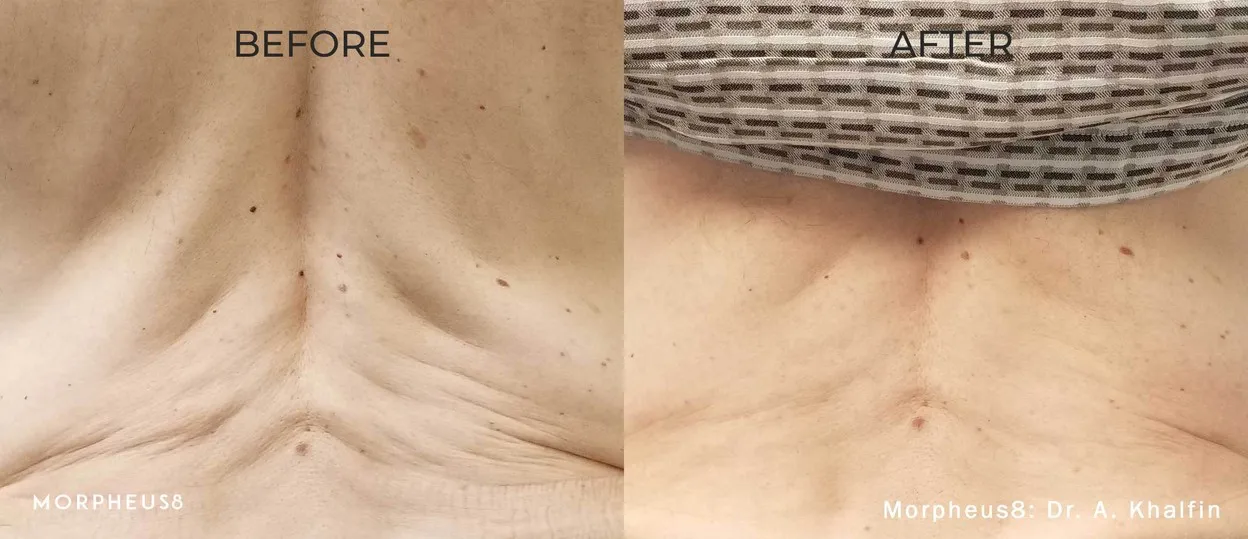
Before and after images bring most people to this question, so be precise about what they are. The pair below is one of the manufacturer’s own, published with a credit to the treating physician. It is not our patient, not a typical result, and not evidence in the sense used above. It shows what a good outcome can look like, and nothing more.
When paying might be defensible
There is a version of this purchase that survives scrutiny. You have a specific, visible concern that heat delivered into soft tissue could plausibly change. A medically qualified practitioner will give you the depth in millimetres and say why that depth for your anatomy. You have read the wider downtime range rather than the reassuring one, and can absorb the cost without needing the result to be permanent. Having seen the evidence quality above, you judge the odds acceptable. That is an informed gamble with your own money, and adults may take those.
When it clearly is not
If a clinic is selling body contouring, fat melting or fat reduction, nothing supports the offer. No clearance names those outcomes, and independent surgical literature documents subcutaneous fat loss as an unwanted complication, not a goal.
If the target is cellulite or stretch marks, the picture is thinner still. The only Morpheus8 cellulite publication is a case series with no retrievable sample size or outcome data, and a different device, Profound, holds the FDA cellulite indication. Morpheus8 specific stretch mark evidence does not exist.
If the target is neck wrinkles and you have been told this outperforms laser, the only independent randomised head to head points the other way: 1550 nm non ablative fractional laser beat radiofrequency microneedling on wrinkle score, 42.1 percent against 8.6 percent. That trial tested radiofrequency microneedling as a class rather than Morpheus8 by name, a real limitation, but it is the only independent comparison there is. What it compared is worth reading before spending anything on the neck.
If it is being sold as a way of avoiding surgery, weigh the sequence rather than the session. An independent review of 180 face and neck lifts found prior deep radiofrequency microneedling made later surgical correction harder, with a deep neck lift required in 91 percent of that series. Money spent now can raise the price of what comes next.
And if what is bothering you is a rash, a changing mole, a lesion or persistent inflammatory acne, that needs a diagnosis rather than a device. See your GP or a dermatologist first, before any aesthetic clinic.
Turning a price into a decision
Nobody can answer worth it for you, but the question can be made answerable. Ask for the total for the whole course, not the session price. Ask how many sessions, and what that number rests on. Ask what happens, and what it costs, if the result disappoints you both. Ask who will hold the handpiece and what they are medically trained in, because that is what the price list is measuring. And ask the clinic to name the evidence behind any claim, then notice whether the answer mentions who paid for it.
If you would rather have those answers about your own face or body than in the abstract, book a consultation with us. What we offer is an honest assessment: what is realistic, what is not, what it would cost in total, and whether this is the right tool for what is bothering you. Sometimes it is not, and that answer costs nothing.
At a glance
Paying for a course, weighed honestly
+ Reasons in favour
- The market is public and comparable. UK clinic price lists put a course of three between £560 and £3,240 depending on the area, so any quote you are given can be measured against a real range
- The published protocol is short and finite. The largest peer reviewed cohort used 1 to 3 sessions spaced 3 to 6 weeks apart, so the full cost of a course is knowable before you commit to the first one
- The biggest price variable is the one you can ask about. The same London clinic charges £1,050 for a full face with a senior doctor and £1,580 with a lead doctor, on the same device, which tells you that you are buying an operator rather than a machine
− Reasons for caution
- Nothing you pay for has been tested against a convincing imitation of itself. No sham controlled randomised trial of Morpheus8 has been published, and the one independent review that excluded industry funded studies rates the evidence base Level of Evidence 5, the lowest rung
- The flagship efficacy data sit in journal supplements sponsored by the manufacturer and written by its consultants, and the largest dataset combined Morpheus8 with a separate radiofrequency device rather than testing it alone
- No controlled durability study exists, so how often you would have to pay again is genuinely unknown. The longest peer reviewed follow up averages 2.1 years and comes from that same sponsor funded retrospective
Frequently asked questions
The short version.
01How much does a course of Morpheus8 cost in the UK?
UK clinic price lists captured during research in 2026 put a single session between £200 for a chin and £1,800 for a body area with the most senior operator, and a course of three between £560 and £3,240. By area, a course of three runs roughly £945 to £1,450 around the eyes, £1,650 to £2,200 for a full face, £1,750 to £3,000 for face and neck, £560 to £1,120 for neck or chin alone, and £840 to £3,240 for the abdomen and similar body areas. Prices move often, so treat these as a map of the market rather than a quote.
02Why do two clinics quote such different prices for the same treatment?
Mostly because you are paying for the person, not the platform. One London clinic lists a full face at £1,050 with a senior doctor and £1,580 with a lead doctor, on the same device in the same building. Location matters too: one London provider characterises the market as running from about £400 at budget clinics to £900 to £2,200 at premium London ones. Area treated and the number of sessions in the package account for most of the rest.
03How many sessions should a course include?
The largest peer reviewed cohort used 1 to 3 sessions, 3 to 6 weeks apart, and the peer reviewed acne work used 3. UK clinic guidance commonly stretches that to 3 to 6 sessions at the same spacing, which materially changes what you pay. If more than three are proposed, ask what that recommendation rests on. Watch the session count in headline prices too: one clinic lists a body package at £3,835, which is a course of six, while its course of three is £2,159.
04How long do the results last, and how often would I pay again?
There is no controlled durability study, so a peer reviewed answer in months or years does not exist. The longest peer reviewed follow up identified averages 2.1 years, and it comes from a sponsor funded retrospective rather than a trial designed to measure durability. The figures that circulate in consumer content, one to three years or twelve to eighteen months, trace back to clinic marketing pages, not to published trials. Dermatologists quoted in the consumer press say the effect is not permanent and that annual maintenance visits should be expected.
05Is a cheaper clinic a false economy?
No study has compared outcomes between UK clinics at different price points, so the honest answer is that nobody knows. What is documented is that the FDA describes radiofrequency microneedling as a medical procedure rather than a cosmetic treatment, and its safety communication of 15 October 2025 lists burns, scarring, fat loss, disfigurement, nerve damage and cases needing surgical repair among reported harms. The question worth asking is therefore not whether a clinic is cheap, but who will hold the handpiece and what they are medically trained in.