
A Morpheus8 quote almost always arrives with a schedule attached. Three sessions, a few days of redness, results that build quietly over the months afterwards. Some of that schedule is written down in the manufacturer’s own operator manual, in more detail than most people expect. Other parts of it are not written down anywhere, and have simply been repeated between clinic websites for long enough to sound official.
What follows is the timeline with its sources attached: the first day, the first three weeks as the company that makes the device describes them, how a course is spaced, when anything visible is supposed to appear, and what the longest published follow-up can and cannot tell you. Where the evidence runs out, this article says so, because the gaps in this calendar are as informative as the milestones.
The first 24 hours
The immediate response is the part everyone describes roughly the same way. The manufacturer’s manual lists erythema, meaning redness, as typical and states that it lasts no longer than 24 hours. Minor pin-point bleeding may occur from the treated dots. Swelling begins in the same window and does not resolve on the same schedule as the redness does.
How that first day goes depends heavily on the settings used. Needle depth and energy level decide how much thermal injury has been placed and how deep, and both vary enormously between a facial treatment and a body one, so the settings menu is worth understanding before your next appointment rather than after it.
Weeks one to three: the range clinics rarely quote
Here the documents disagree, and the disagreement is the single most useful thing in this article.
The peer-reviewed protocol from the largest published cohort records 2 to 5 days of downtime. That is the figure clinics quote, and it is genuinely published. The manufacturer’s own operator manual describes something considerably longer: oedema for 1 to 3 weeks, and crusting from the treated dots exfoliating naturally after 1 to 3 weeks. Independent review authors add that the visible grid pattern left by the needle array persists for 1 to 2 weeks.
Both are legitimate. They measure different things: how long before you can face the world, versus how long before the skin has finished healing. For planning, the wider range is safer, because a wedding or a work event falls on a fixed date and swelling does not negotiate.
A minority take longer still. In the 247 patient cohort, swelling persisted beyond 6 weeks in 4.8 percent and hardened areas beyond 12 weeks in 3.2 percent. Small percentages, but not zero, and worth knowing before you book anything into week seven.
The aftercare that sets the pace
The manufacturer’s instructions attach two requirements to the calendar, and both are longer than people expect.
The first is sun protection: SPF 30 or higher, with the treated area protected from over-exposure to sunlight for at least one month afterwards. The second is stricter. Excessive tanning of any kind is prohibited for the entire treatment course, not merely between one session and the next. Set that against a course running over two or three months and most of a British summer’s sunbathing has left the plan. It is a genuine scheduling constraint, not a suggestion.
There is a third instruction that applies to some skin tones and not others. For Asian patients and for Fitzpatrick types IV and V, the manual says a physician may prescribe a bleaching regimen for 6 to 12 weeks, applied 2 to 3 times weekly once healing is complete at around 7 days, then stopped 48 to 72 hours before the next session, to reduce the risk of post-inflammatory hyperpigmentation. If that applies to you, the fuller picture for darker skin belongs in your consultation, because it changes the energy settings as well as the aftercare.

How a course is spaced
Session spacing is one of the better documented parts of this treatment.
| Source | Protocol |
|---|---|
| Largest peer-reviewed cohort, 247 patients | 1 to 3 sessions, 3 to 6 weeks apart |
| Peer-reviewed acne and acne scarring work | 3 sessions |
| Manufacturer’s manual, darker skin protocol | Retreatment every 3 to 4 weeks when escalating energy in Fitzpatrick V to VI |
| UK clinic guidance | 3 to 6 sessions, 3 to 6 weeks apart |
Notice the last row. UK clinics commonly quote a course of up to six sessions, where the published protocol behind the most cited dataset used one to three. That difference has a cost attached to it, and it is fair to ask why the recommendation for you sits where it does.
Three sessions at three to six week intervals puts your final appointment roughly 6 to 12 weeks after your first, with the healing period from that last session on top.
When anything visible is supposed to appear
The stated mechanism is thermal. Peer-reviewed description of the device reports that heating soft tissue to approximately 50 degrees Celsius, while the skin surface stays at 40 to 42 degrees, induces the production of collagen and elastin along with angiogenesis, the growth of new small blood vessels. Remodelling of that kind is slow by nature, which is the honest basis for the standard line that results build over months rather than days.
What does not exist is a study that measured it. No published research tracks a Morpheus8 result week by week, or says what proportion of the final change has arrived by week four, week twelve or week twenty-four. When a clinic shows you a curve, it illustrates wound healing in general, not this machine.
The closest available figure is heavily qualified. In a small prospective study of jowl and neck laxity in patients who had had a facelift one to five years earlier, blinded investigators rated 33 percent as markedly improved at three months, rising to 55 percent at six months. Only nine patients completed it, and Morpheus8 was combined with a second device. A hint about pace, not a schedule you can hold anyone to.
How long the result holds
This is where the timeline stops being documented at all.
The longest peer-reviewed follow-up identified for Morpheus8 is an average of 2.1 years, from a multicentre retrospective. Three things need saying alongside that number. All of its authors were consultants to the manufacturer. It reports largely the same patients as the earlier flagship paper, so it is not independent replication. And the treatment it describes combined Morpheus8 with FaceTite and BodyTite, separate radiofrequency devices, rather than using Morpheus8 on its own.
Beyond that, there is nothing. No controlled durability study of this device has been published, so a peer-reviewed answer in months or years simply does not exist. The figure you will see most often online, one to three years, traces back to clinic marketing pages rather than to any trial, and should not be presented to you as evidence. Dermatologists quoted in the consumer press are more measured: the effect is not permanent, and annual maintenance visits are the usual recommendation. What that maintenance means for the total cost of the treatment is worth working out before the first session, not after the third.
The most quoted durability figure for this treatment has no trial behind it. The best one that does comes from a study written by the manufacturer’s own consultants.
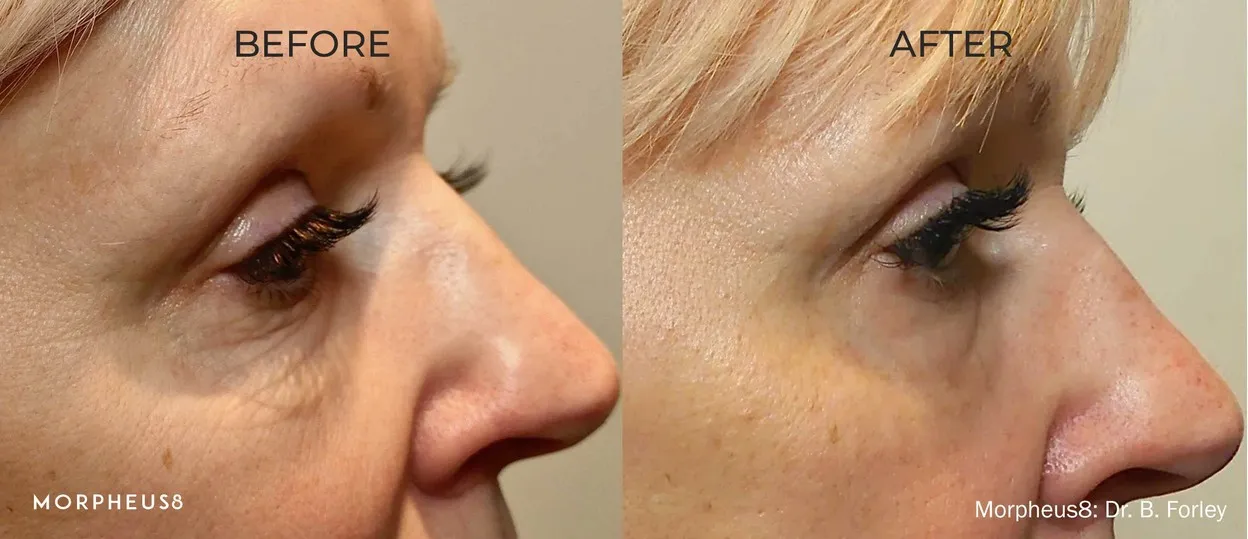
The manufacturer’s before and after photographs, including the one below, are single fixed time points from patients treated by named physicians in other clinics. They are not our patients, and they are not a timeline: nothing records how those images would have looked a year later.
What no timeline can be cleared for
One more piece of context belongs here, and it is the piece most clinic pages omit.
Morpheus8 is 510(k) cleared by the FDA, not FDA approved. Clearance is a substantial equivalence pathway, in which a manufacturer shows its device is similar enough to one already on the market. It is not a finding that the device produces any particular outcome on any particular schedule. The cleared wording covers dermatologic procedures where coagulation or contraction of soft tissue, or haemostasis, is needed. No Morpheus8 clearance names wrinkles, skin tightening, acne scars, cellulite, stretch marks, body contouring or fat reduction, so there is no cleared cosmetic result for a timeline to lead towards.
No sham-controlled randomised trial of Morpheus8 has been published, and the one independent systematic review that excluded industry-funded studies rates the radiofrequency microneedling evidence base at Level of Evidence 5, the lowest rung. The FDA safety communication of 15 October 2025 covers radiofrequency microneedling as a class, reporting burns, scarring, fat loss, disfigurement, nerve damage and cases requiring surgical repair, and stating plainly that this is a medical procedure and not a cosmetic treatment. A medical procedure deserves a realistic recovery plan.
Building a realistic calendar
Work backwards from what is documented. Allow up to three weeks of visible healing per session rather than the few days you may have been quoted, space sessions three to six weeks apart, and expect a three session course to occupy two to three months end to end, with sun protection running a further month and no tanning across the whole period. Treat any promise of a specific result by a specific date as marketing rather than evidence.
If you would like that calendar built around your own skin and your own diary, book a consultation with us. We will go through the depth and energy your area would need, how healing is likely to run for your skin type, what maintenance would realistically involve, and whether this is the right tool for what is bothering you at all. If what you describe sounds like something that needs diagnosis rather than treatment, we will say so and send you to a GP or dermatologist first.
At a glance
The schedule, weighed honestly
+ Reasons in favour
- The course itself is knowable before you book. Published protocols run 1 to 3 sessions spaced 3 to 6 weeks apart, so the treatment has a defined beginning and end rather than an open-ended commitment
- The manufacturer's own manual puts the healing period in writing: erythema typically lasting no longer than 24 hours, then oedema and crusting resolving over 1 to 3 weeks. Nothing about the first month needs to be a surprise
- Aftercare is specific rather than vague. SPF 30 or higher, protection from over-exposure to sunlight for at least a month, and no excessive tanning at any point during the course
− Reasons for caution
- No published study tracks how a Morpheus8 result develops week by week, so any confident month-by-month graph you are shown is a description of wound healing in general rather than a measurement of this device
- The healing range in the manufacturer's manual is far longer than the one clinics quote: oedema and crusting over 1 to 3 weeks, against 2 to 5 days of downtime in the published protocol
- Durability is the weakest part of the whole picture. The longest peer-reviewed follow-up averages 2.1 years, in a retrospective whose authors were all consultants to the manufacturer, and no controlled durability study exists at all
Frequently asked questions
The short version.
01How long does it take to see results from Morpheus8?
There is no published study that measures this week by week, which is the honest answer. The mechanism is thermal: peer-reviewed description of the device reports that heating soft tissue to roughly 50 degrees Celsius induces collagen and elastin production along with the growth of new small blood vessels, and that kind of remodelling is gradual rather than immediate. The nearest thing to a measured onset comes from a small prospective study in which only nine patients completed the protocol, where blinded investigators rated 33 percent markedly improved at three months, rising to 55 percent at six months. Those patients had a combination treatment and had all had a facelift one to five years earlier, so the figure is a hint rather than a schedule.
02How many Morpheus8 sessions will I need, and how far apart?
The largest peer-reviewed cohort used 1 to 3 sessions spaced 3 to 6 weeks apart. The peer-reviewed work on acne and acne scarring used 3 sessions. UK clinic guidance commonly quotes 3 to 6 sessions at the same 3 to 6 week spacing, which is more sessions than the published protocol used. The manufacturer's manual sets a retreatment interval of every 3 to 4 weeks when energy is being escalated in Fitzpatrick skin types V and VI. A three session course therefore runs roughly 6 to 12 weeks from the first appointment to the last.
03How long do the results actually last?
The longest peer-reviewed follow-up identified is an average of 2.1 years, in a multicentre retrospective whose authors were all consultants to the manufacturer, and which reported largely the same patients as the earlier flagship paper. There is no controlled durability study, so a peer-reviewed figure for how long a cosmetic result holds is simply not available. The figure most often repeated online, one to three years, traces back to clinic marketing pages rather than to any trial. Dermatologists quoted in the consumer press state that the effects are not permanent and that annual maintenance visits are advisable.
04How long is the downtime, really?
It depends which document you read, and the two do not agree. The peer-reviewed protocol records 2 to 5 days of downtime. The manufacturer's operator manual describes erythema typically lasting no longer than 24 hours, oedema for 1 to 3 weeks, and crusting from the treated dots exfoliating naturally after 1 to 3 weeks, with minor pin-point bleeding possible. Independent review authors note visible grid marks persisting for 1 to 2 weeks. In the 247 patient cohort, swelling lasted beyond 6 weeks in 4.8 percent and hardened areas persisted beyond 12 weeks in 3.2 percent. Plan around the wider range.
05What do I have to do between sessions?
The manufacturer's manual asks for SPF 30 or higher and protection of the treated area from over-exposure to sunlight for at least one month after treatment, and prohibits excessive tanning of any kind for the entire treatment course, not just between individual sessions. For Asian patients and for Fitzpatrick skin types IV and V, the manual says a physician may prescribe a bleaching regimen for 6 to 12 weeks, applied 2 to 3 times weekly once healing is complete at around 7 days, and stopped 48 to 72 hours before the next session, to reduce the risk of post-inflammatory hyperpigmentation.