
“Better than laser” turns up on clinic pages for this treatment constantly, usually a line or two away from “gold standard”. It is one of the few claims in aesthetics that can be checked against a randomised trial, because a comparison was run, independently of any manufacturer, and published in 2022. It did not go the way the marketing goes. It is also routinely misdescribed in the other direction, by people who have read the headline number and assumed it was a Morpheus8 study. It was not, quite. Here is what was compared, what the numbers were, and what the result actually entitles anyone to say.
One randomised comparison, and how it came out
A randomised split comparison published in 2022 in Dermatologic Surgery treated the necks of 21 patients with radiofrequency microneedling on one side and a 1550 nm non-ablative fractional laser on the other, three treatments given four weeks apart. Splitting treatment across one person’s own neck removes the differences between patients that muddy most aesthetic comparisons.
| Outcome measure | Radiofrequency microneedling | 1550 nm non-ablative fractional laser |
|---|---|---|
| Fitzpatrick-Goldman Wrinkling Score | 8.6 percent improvement | 42.1 percent improvement |
| Elastosis | 16.3 percent improvement | 41.3 percent improvement |
| Horizontal Neck Wrinkle Severity scale | The better of the two arms | The weaker of the two arms |
| Patient satisfaction | Lower | A trend toward higher satisfaction |
The margins on the first two rows are not subtle, and elastosis, the loss of skin elasticity that gives an ageing neck its crepey quality, is the harder of the two to shift. Radiofrequency microneedling took one measure, the horizontal neck wrinkle scale, which is a real finding and not a consolation prize: the two modalities are not better and worse versions of each other, but are doing different things that different scoring systems pick up.
What the trial tested, and what it did not
This is the part to be precise about, because both of the convenient summaries are wrong.
The study is recorded as radiofrequency microneedling against a fractional laser. It is not confirmed as a trial of Morpheus8 specifically. So it is not a documented defeat for this brand, and anyone presenting it that way is overreaching. Equally, it is not a result Morpheus8 gets to be exempted from, because it is evidence about the category this device sits in, tested with the same physics and the same broad approach.
It is also a small trial. Twenty-one patients, one body area, one laser wavelength, three sessions. That is enough to unsettle a marketing claim and nowhere near enough to settle a treatment decision. What it does establish, firmly, is that radiofrequency microneedling is not automatically the stronger option when it is put beside established laser resurfacing and actually measured.
Two different ways of getting heat into skin
The devices reach the same tissue by opposite routes, which is why they score differently.
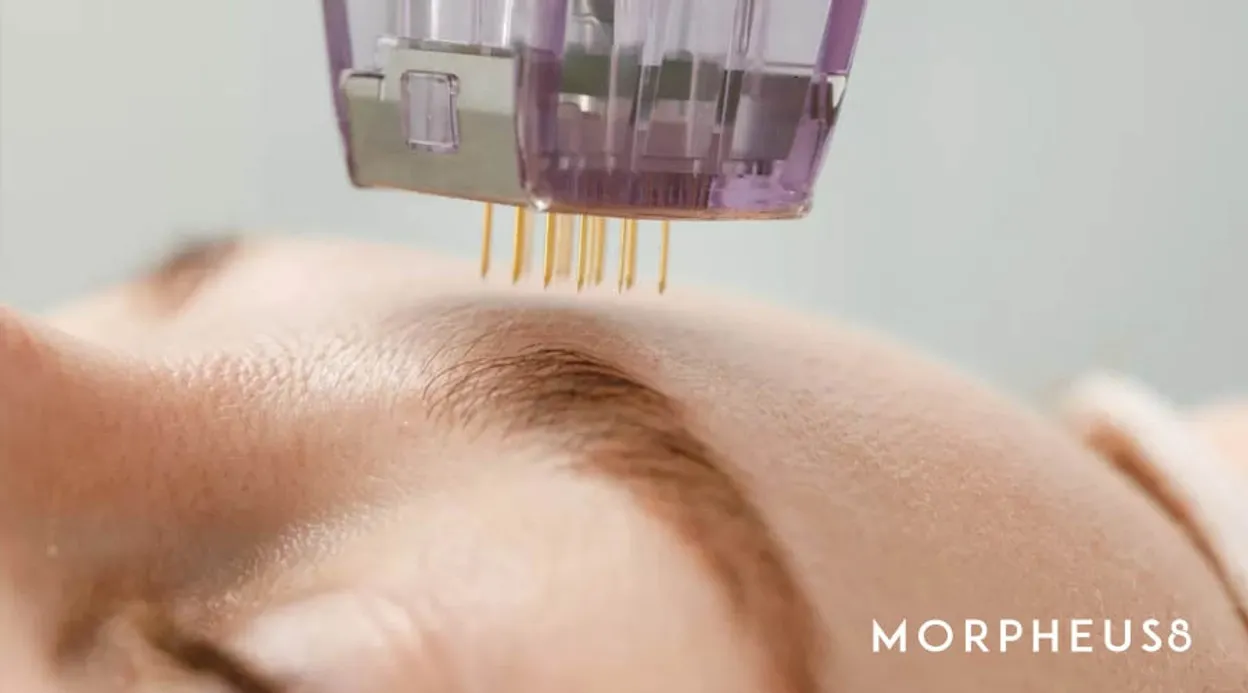
Morpheus8 makes holes. An array of gold-coated needle electrodes is driven mechanically to a preset depth, and bipolar radiofrequency at 1 MHz, up to a maximum of 65 watts, is then discharged between pairs of them. Each needle is insulated along its whole length except the final 0.5 mm at the tip, so current cannot escape into the tissue the needle passed through: the heat forms a defined zone at the bottom of the tract, at a depth the operator selects. Energy reaches less than 5 percent of the treated area at a time. The manufacturer’s manual offers 1 to 7 mm of needle depth with roughly a further millimetre of thermal effect, while the FDA summary for the original clearance states a maximum treatment depth of 4.0 mm, and the tissue reached beyond 4 mm is subcutaneous fat rather than skin. The settings that decide all of this are the treatment.
A non-ablative fractional laser puts nothing into the skin. It delivers energy optically at a wavelength of 1550 nm, in a fractional pattern, in the same sense that the radiofrequency device is fractional: a proportion of the area is treated at a time and untreated tissue is left in between. Non-ablative means the surface is heated rather than removed.
One honest gap belongs here. The published comparison gives the laser’s wavelength and little else, so there is no matched depth or energy figure to set against the millimetres quoted for Morpheus8. If a clinic offers you one, ask where it came from.
Why “better than laser” is a claim to refuse
Hold the trial result and the advertising claim next to each other. The claim is that this device outperforms laser resurfacing. The only independent randomised test of anything resembling that proposition found the laser ahead on two of the three objective measures used, with satisfaction trending the same way. A claim contradicted by the sole trial that examined it does not belong in an advert, and we will not make it.
The same discipline applies inside the device category. No head-to-head trial of Morpheus8 against another radiofrequency microneedling brand has been identified at all. That absence is symmetrical: it undermines any claim that Morpheus8 beats its competitors, and any claim that they beat it. Where nothing has been compared, nothing has been shown, and the gap between what is claimed and what has been tested is wide enough to be the real story of this treatment.
The evidence base, sorted by who funded it
The head-to-head is worth putting in context, because its independence is unusual. Set the main published datasets side by side with who paid for them and a pattern appears.
| Indication | Best available evidence | Patients | Independence |
|---|---|---|---|
| Face and neck laxity | 2019 and 2020 retrospective series | 247, the same cohort reported twice | InMode funded, all authors InMode consultants |
| Acne and acne scarring | 2025 retrospective comparison | 139 in the radiofrequency arm | InMode sponsored supplement |
| Neck wrinkles against the laser | 2022 randomised split comparison | 21 | Independent, radiofrequency microneedling underperformed |
| Body treatment with nanofat | 2025 retrospective series | 20 | No financial interest declared |
| Fat loss as a harm | 2025 retrospective surgical review | 180 | Fully independent |
| Sham controlled randomised trial | None identified | Not applicable | Not applicable |
Read the right-hand column downwards. The flattering datasets are the sponsored ones. That does not make the sponsored findings false, and it is not an accusation against anyone. It does mean that citing “multiple published studies” without saying who funded them is misleading, and it explains why the one independent systematic review that excluded industry funded studies rates this whole evidence base at Level of Evidence 5, the lowest rung there is.
The two fully independent studies in this field are a comparison the device class lost and a review of harm. That is worth knowing before anyone quotes you a study count.
What the regulator has actually cleared
None of the above is what a clearance measures, which is its own problem.
Morpheus8 is 510(k) cleared, not FDA approved. Clearance is a substantial equivalence pathway: the manufacturer showed the device is similar enough to one already on the market. It is not a finding that the device works for any cosmetic purpose. The current cleared wording covers dermatologic procedures where coagulation or contraction of soft tissue, or haemostasis, is needed, and haemostasis means stopping bleeding. No Morpheus8 clearance names wrinkles, skin tightening, acne scars, cellulite, stretch marks, body contouring or fat reduction. The 2023 expansion to that soft tissue wording went through as a Special 510(k) recording clinical performance data as not applicable, supported by bench work rather than a trial. No sham controlled randomised trial of Morpheus8 exists.
One detail matters especially for a neck article. A plain mechanical microneedling device, with no radiofrequency at all, holds cleared cosmetic indications covering facial acne scars and neck wrinkles, and the acne scar one was granted through a pathway that required clinical study data. Morpheus8, the deeper and considerably more expensive option, holds no cosmetic indication whatsoever.
And in October 2025 the FDA issued a safety communication on radiofrequency microneedling as a class, reporting burns, scarring, fat loss, disfigurement, nerve damage and cases requiring surgical repair, and stating plainly that this is a medical procedure, not a cosmetic treatment. That sentence should change how the comparison is framed. You are not choosing between two beauty treatments.
Choosing between them without a winner
So what survives all of that? Depth does. Reaching subcutaneous fat with controlled heat is the genuine argument for this device, and it is why it is used for jowls, submental laxity and body areas rather than surface texture. The same depth is the source of its distinctive harm profile: the independent surgical review of 180 face and neck lifts named Morpheus8 specifically in connection with subcutaneous fat loss and contour irregularity.
The practical differences are worth weighing too. Published downtime for radiofrequency microneedling runs at 2 to 5 days, though the manufacturer’s own manual describes oedema and crusting resolving over 1 to 3 weeks, which is the range we quote. UK pricing sits at roughly £200 to £1,800 per session depending on the area and who holds the handpiece, and whether that is money well spent depends on what you are actually trying to change.
If your concern is fine neck wrinkling and sun damage in the upper layers of the skin, the one randomised comparison available points toward a laser. If it is laxity involving the tissue underneath, that comparison does not answer your question, and nothing published answers it cleanly. Book a consultation with us and we will tell you which of those two situations you are in, in plain terms, including when the honest answer is that a different treatment, or a different clinic’s machine, would serve you better than ours.
At a glance
The head-to-head evidence, weighed honestly
+ Reasons in favour
- The comparison is genuinely independent and randomised, a split study on the neck across three treatments four weeks apart, which is a stronger design than almost anything else in this literature
- Radiofrequency microneedling did beat the laser on one of the measures used, the Horizontal Neck Wrinkle Severity scale, so the result is not a clean sweep in either direction
- Depth remains a real technical difference. The manufacturer's manual offers needle depths of 1 to 7 mm, and the tissue reached above 4 mm is subcutaneous fat, which is the stated rationale for using this device on jowls and body areas
− Reasons for caution
- The laser outperformed radiofrequency microneedling on the trial's wrinkle score by 42.1 percent to 8.6 percent, and on elastosis by 41.3 percent to 16.3 percent, with a satisfaction trend toward the laser
- The trial tested radiofrequency microneedling as a class and is not confirmed as a Morpheus8 study, so it cannot honestly be read as a verdict on this specific device in either direction
- Only 21 patients took part, on one body area, against one laser wavelength, which is a narrow base for any general conclusion about either modality
Frequently asked questions
The short version.
01Is Morpheus8 better than laser?
Nobody can say that, and no clinic should. The only independent randomised comparison between radiofrequency microneedling and another modality found the opposite on the neck: a 1550 nm non-ablative fractional laser improved the wrinkle score by 42.1 percent against 8.6 percent for radiofrequency microneedling, and elastosis by 41.3 percent against 16.3 percent. Radiofrequency microneedling did better on one scale, the Horizontal Neck Wrinkle Severity scale. A claim of general superiority over lasers is contradicted by the only trial that tested it.
02Was that trial actually a Morpheus8 study?
Not confirmed. The published comparison is recorded as radiofrequency microneedling against a 1550 nm non-ablative fractional laser, which makes it evidence about the class of device Morpheus8 belongs to rather than a trial of the branded platform. That cuts both ways. It is not a documented defeat for Morpheus8, and it is not a result Morpheus8 can be exempted from either.
03Has Morpheus8 been compared against other radiofrequency microneedling brands?
No head-to-head trial of Morpheus8 against another radiofrequency microneedling brand has been identified. That means claims of superiority over Genius, Potenza, Secret RF, Vivace or any other device are unsupported, and so are claims in the opposite direction. Where nothing has been compared, nothing has been shown.
04Is Morpheus8 FDA approved for wrinkles?
No, on both counts. It is 510(k) cleared, not approved, which is a substantial equivalence pathway rather than a finding that a device works. The current cleared wording covers dermatologic procedures where coagulation or contraction of soft tissue, or haemostasis, is needed. No Morpheus8 clearance names wrinkles, skin tightening, acne scars, cellulite, stretch marks, body contouring or fat reduction.
05So which should I choose for my neck?
That is a question for a consultation rather than an article, because the trial that exists covered 21 patients, one body area and one laser wavelength, and the honest reading of it is that neither modality has been shown to be the right answer for everyone. What you can reasonably do is ask any clinic proposing one of them why that one, what it reaches that the alternative does not, and what evidence they are relying on.