
Of all the harms now formally attached to radiofrequency microneedling, one reads strangely, because it also appears in the marketing. Fat loss. The FDA lists it among reported adverse events. InMode sells a product category built around remodelling the fat beneath the skin. Both descriptions point at the same physical event: heat delivered below the dermis, into subcutaneous fat, doing what heat does to fat.
What turned that from a theoretical worry into documented harm was not a regulator and not a marketing dispute. It was a group of surgeons operating on 180 necks and writing down what they found underneath. Their review is the most specific independent evidence of harm published about this treatment, it names Morpheus8, and it deserves to be read carefully rather than loudly, because the detail is where the useful information sits.
What the surgeons found
The paper is a 2025 retrospective review in Aesthetic Surgery Journal covering 180 face and neck lifts performed in 2023. Its authors declare no conflicts of interest and no funding, which is worth pausing on, because a large share of the published Morpheus8 literature appears in journal supplements sponsored by InMode and authored by InMode consultants. This one does not.
Of those 180 patients, 123, or 68 percent, had already had some intervention on the neck. Thirty seven of those prior interventions were non-surgical.
Operating on that group, the authors describe finding a layer of fibrosis between the skin and the superficial cervical fascia: scar tissue sitting where the planes a surgeon works in should separate cleanly. They name Morpheus8 specifically among the devices that penetrate more deeply, and record irregularities related to greater subcutaneous fat loss in areas felt to correspond to the areas of needle penetration.
That last phrase is the one to hold on to. Not a general thinning of the face with age, but a pattern that matched where the needles had gone in.
The part that is difficult to undo
The review is blunt about the consequences. Loss of subcutaneous fat made achieving smooth contours in the neck exceptionally difficult, if not impossible. It raised the risk of submental skin loss, meaning skin under the chin failing to survive the surgery. A deep neck lift was required in 91 percent of cases, and contour irregularities were seen in nearly 100 percent.
Then a smaller number, which says more about consent than about surgery: five patients, 4 percent of the series, had not told their surgeon about prior non-surgical treatment at all. What had been done to their tissue was discovered on the operating table.
Why depth explains all of it
Nothing here is mysterious once the mechanics are on the table.
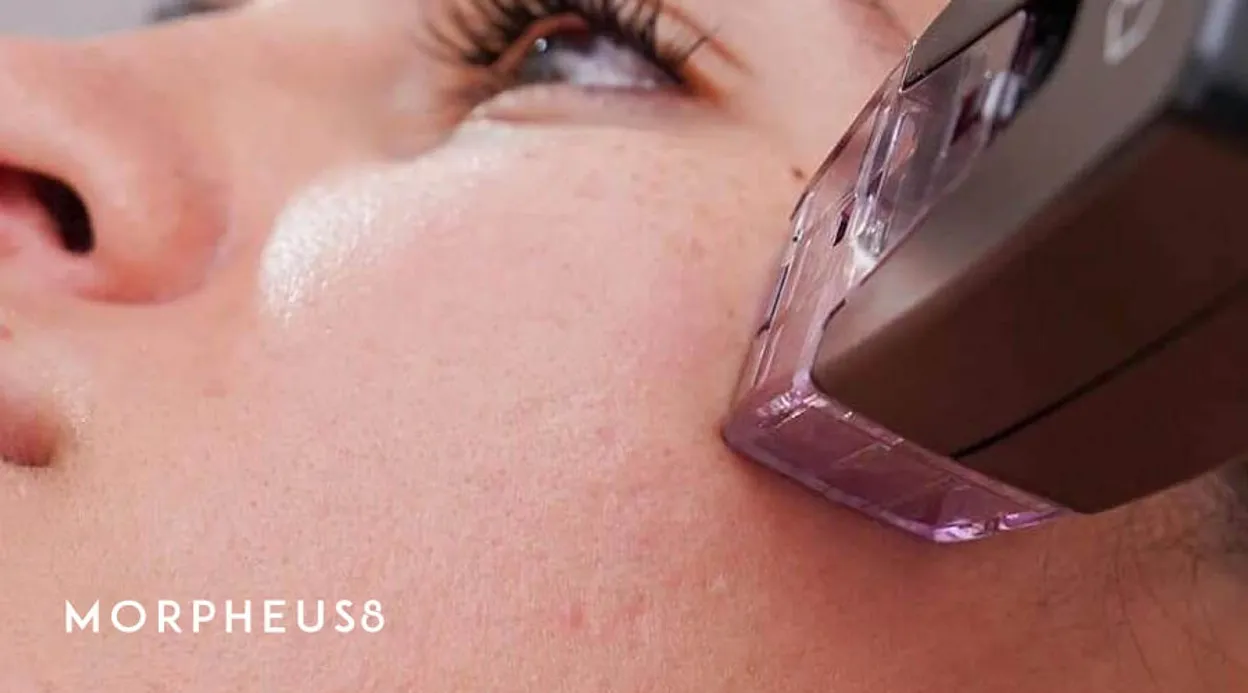
Each Morpheus8 needle is insulated along its length except the final 0.5 mm at the tip, so radiofrequency energy can only discharge at the bottom of the needle tract rather than along the whole channel. Wherever the tip stops is where the heat forms, plus roughly a millimetre beyond it.
Which makes depth the only question that matters. The manufacturer’s operator manual offers 1 to 7 mm on the standard 24 pin tip and 2 to 7 mm on the 40 pin body tip, in 1 mm steps. The FDA summary for the original clearance states a maximum treatment depth of 4.0 mm. And the manual carries one sentence that explains this entire article: depth settings above 4 mm are used for treatment areas with subcutaneous fat thickness of 1 cm or higher.
Read plainly, that is the manufacturer saying what the deepest settings are for. They are for places where there is a centimetre of fat to work in. Published clinical practice keeps facial treatment at 1 to 2 mm and body treatment at 3 to 4 mm, which is why the settings are the treatment rather than a technical footnote on a quote.
Heat at depth is not selective, though. It coagulates whatever tissue it reaches, and the surgical review describes the resulting loss as something later surgery had to work around, not something that resolved on its own.
The same effect, filed under two headings
InMode markets a category it calls subdermal adipose remodelling devices, and positions Morpheus8 Body inside it. That is a manufacturer’s marketing category rather than an FDA device classification, and the difference matters, because no Morpheus8 clearance mentions fat reduction or body contouring anywhere at all. Marketing language and cleared language part company here more visibly than almost anywhere else in this treatment’s paperwork.
So the fair statement of the position is this. Heating subcutaneous fat is a documented capability of the device. The manufacturer describes it as a benefit. Independent surgeons describe it as a complication. The regulator does not describe it as an indication. None of those three is lying, and none of them contradicts the others. It comes down to whether the fat in question was fat you wanted to keep.
The same tissue effect is a selling point in one document and an adverse event in another. The tissue cannot tell the difference.
What the regulator has said
On 15 October 2025 the FDA published a safety communication on radiofrequency microneedling, reporting burns, scarring, fat loss, disfigurement, nerve damage and the need for surgical repair. Its flattest sentence is the most quoted: radiofrequency microneedling is a medical procedure, not a cosmetic treatment. The FDA added that these devices should not be used at home, that its evaluation is ongoing, and that it is working with manufacturers.
Two professional societies responded jointly that December. Their position was that radiofrequency microneedling performed in appropriate settings is safe and effective, and that members should add burns, scarring, fat loss, disfigurement and nerve damage to their consent forms. That is the practical consequence of all this: not a withdrawal, but a change in what a patient has to be told before agreeing.
None of it rests on a strong evidence base. Morpheus8 is 510(k) cleared rather than FDA approved, which is a substantial equivalence pathway rather than a finding that a device works. Its cleared wording covers dermatologic procedures where coagulation or contraction of soft tissue, or haemostasis, is needed, and haemostasis means stopping bleeding. No sham controlled randomised trial of Morpheus8 has been published, and the one independent systematic review that excluded industry funded studies rates the radiofrequency microneedling evidence base at Level of Evidence 5, the lowest tier there is.
What nobody can tell you
Here is the gap, and it is a wide one. There is no incidence figure for fat loss.
The surgical review records the finding qualitatively, in patients who had already had deeper radiofrequency microneedling and who then presented for a face or neck lift. That is a selected group by definition: people who went on to see a surgeon. It cannot tell you what proportion of everyone treated is affected, and no published study fills that in.
Other adverse events do carry rates, from the largest published cohort of 247 patients: prolonged swelling beyond six weeks in 4.8 percent, a hardened area persisting beyond twelve weeks in 3.2 percent, and neuropraxia, a temporary problem with nerve conduction, in 1.2 percent. Visible grid marks last one to two weeks. And the independent review names the largest single risk factor plainly, which is not the machine at all: the highest conferred risk of complications was user error.

If you have already had this treatment
Two things follow, and the first is not a sales point.
If you have noticed a change in the contour of your cheeks, jaw or neck since treatment, or a hollow or a firm band that was not there before, that needs a diagnosis rather than another treatment. See your GP, or ask to be referred to a dermatologist. A clinic that sells the procedure is not the right first stop for assessing a suspected complication of it, and nothing written here is a substitute for someone examining you.
Second, tell any future surgeon, and do it unprompted. Four percent of the patients in that series did not, and what was waiting under the skin was fibrosis nobody had planned for. Prior radiofrequency microneedling belongs in your medical history alongside anything else that has altered the tissue, and it belongs there whether the treatment went well or badly. Anyone weighing this treatment against surgery should also understand that the two are not independent choices: having one can change what the other is able to achieve later.
If you are considering it now
None of this makes the treatment indefensible, and it is not an argument that everyone treated at facial depths will lose facial fat. It is an argument for specificity. The harm documented in that review is a depth harm, and depth is a number a person selected.
So ask for the number. Which tip, what depth in millimetres, on which area, and why that depth for your anatomy. Ask whether any setting above 4 mm is planned anywhere on your face, and if it is, what fat thickness the practitioner believes is there. Ask who will be holding the handpiece and what they are trained in. Someone who chose those settings deliberately will answer without hesitating, and someone who cannot answer has told you something more useful than any brochure could.
If you would rather have those answers about your own face than in the abstract, book a consultation with us. We will go through depth, energy, suitability and the realistic ceiling in plain numbers, including an honest view of whether this is the right tool for what is bothering you, or whether it is not.
At a glance
The fat loss evidence, weighed honestly
+ Reasons in favour
- The harm signal is independent. The 2025 surgical review that documented subcutaneous fat loss came from authors declaring no conflicts of interest and no funding, in a literature otherwise dominated by InMode sponsored supplements written by InMode consultants
- The mechanism is legible rather than mysterious. The manufacturer's own manual states that depth settings above 4 mm are for treatment areas with subcutaneous fat 1 cm thick or more, so what those settings reach is a matter of record
- Depth is a choice someone makes, and you are entitled to ask what it will be. Published facial practice sits at 1 to 2 mm, well above the fat, and any clinic can give you the number in millimetres before you agree to anything
− Reasons for caution
- No incidence figure exists. The surgical review records fat loss qualitatively, in patients who had already gone on to see a surgeon, so nobody can tell you what proportion of treated faces are affected
- Where it happened, correction was described as exceptionally difficult, if not impossible, and a deep neck lift was required in 91 percent of the cases reviewed
- The finding sits inside a wider evidence vacuum. No sham controlled randomised trial of Morpheus8 has been published, and the one independent review that excluded industry funded studies rates the field at Level of Evidence 5
Frequently asked questions
The short version.
01Can Morpheus8 cause facial fat loss?
Loss of subcutaneous fat is documented in independent surgical literature. A 2025 retrospective review of 180 face and neck lifts, by authors declaring no conflicts of interest and no funding, names Morpheus8 specifically among deeper penetrating devices and records irregularities related to greater subcutaneous fat loss in areas felt to correspond to the areas of needle penetration. The FDA's safety communication of 15 October 2025 also lists fat loss among reported harms of radiofrequency microneedling as a class. Neither source establishes how often it happens.
02How common is fat loss after radiofrequency microneedling?
Nobody knows, and that is the honest answer. The surgical review records the finding qualitatively, in patients who had already had deeper radiofrequency microneedling and who then presented for a face or neck lift. That is a selected group by definition. No published study reports an incidence rate for fat loss, in contrast to other adverse events where rates do exist, such as prolonged swelling beyond six weeks at 4.8 percent and neuropraxia at 1.2 percent in a 247 patient cohort.
03Does the fat come back?
The surgical review does not describe it resolving. It describes surgeons working around it: loss of subcutaneous fat made achieving smooth contours in the neck exceptionally difficult, if not impossible, raised the risk of submental skin loss, and a deep neck lift was needed in 91 percent of cases. Treat any claim that the effect is temporary as unsupported, because no published evidence was found that establishes it.
04I have had Morpheus8. Should I tell a surgeon?
Yes, and it matters more than most people assume. In that 180 patient series, five patients, 4 percent, had not disclosed prior non-surgical treatment, and the fibrosis between skin and superficial cervical fascia was found during surgery instead. Prior radiofrequency microneedling belongs in your medical history whether the treatment went well or badly, because it changes the tissue a surgeon will be working in.
05Does the FDA safety communication mean Morpheus8 should not be used?
No. The communication of 15 October 2025 does not withdraw any device. It reports burns, scarring, fat loss, disfigurement, nerve damage and the need for surgical repair, states that radiofrequency microneedling is a medical procedure and not a cosmetic treatment, says the devices should not be used at home, and notes that the FDA's evaluation is ongoing. Two professional societies responded that the procedure is safe and effective in appropriate settings, while urging practitioners to add those specific harms to their consent forms.